Senittahna Script Font for Handmade Branding & Printables
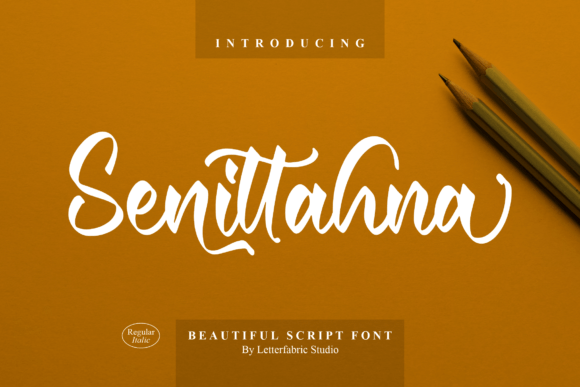
It started with a candle label — one I’d sketched by hand, then scanned, then stared at for twenty minutes trying to match that soft, confident flow in digital form. That’s when I opened my font library and typed “Senittahna.” Instantly, the swirls felt familiar: graceful but grounded, elegant but approachable — exactly the Script Handwritten warmth my small-batch soy candles needed. Senittahna isn’t just another decorative Fonts download. It’s the kind of script font that makes your product labels look thoughtfully designed, not hastily typed.
Senittahna for Candle Labels and Homeware Packaging
I tested Senittahna on matte kraft labels for lavender-vanilla candles — pairing it with a clean sans serif for ingredients and burn instructions. The contrast worked beautifully: Senittahna carried the soul of the brand (soft, natural, handmade), while the supporting type kept things legible and trustworthy. Because Senittahna is a display-focused Script Handwritten font, it shines best at medium-to-large sizes — think 18–36pt on 2” x 3” labels. At smaller sizes (under 12pt), some delicate swashes soften, so I avoided using it for tiny batch numbers or fine-print warnings. For homeware designs like ceramic mugs or linen tea towels, I used Senittahna for short phrases only — “Brew Slowly,” “Good Morning,” or just a single name — letting the curves breathe on the surface.
Senittahna for Wedding Invitations and Elegant Branding
Last spring, I designed a set of botanical wedding invitations for a friend. She wanted “timeless but not stiff,” and Senittahna delivered — especially with its included ligatures and alternate characters. I used the swash capital “S” for “Sarah & James,” then switched to standard lowercase for the date and location. Because Senittahna is a premium Fonts option built for branding projects, it held up across print, PDF, and social media previews without pixelation or awkward spacing. When paired with a gentle serif like Playfair Display or a light sans like Montserrat Light, Senittahna became part of a cohesive visual language — not just decoration, but intentional typography.
Senittahna for Printable Wall Art and Digital Downloads
My best-selling printable wall art piece — “You Are Enough” in soft sage and cream — uses Senittahna as the central phrase. Its open letterforms and subtle bounce give the quote emotional weight without looking overly ornate. As a Script Handwritten font, Senittahna avoids the stiffness of calligraphy fonts meant for formal certificates — instead, it feels personal, like something written just for the viewer. For digital downloads, I always check that Senittahna includes OTF and TTF files (it does), and I confirm commercial licensing covers resale of printed art and editable Canva templates. No surprises — just smooth integration into my shop’s design workflow.
Senittahna for Tote Bags, T-Shirts, and Shopping Bags
I recently screen-printed a limited run of canvas tote bags with “Made With Love” in Senittahna. Because the font has generous x-height and clear spacing between letters, it scaled cleanly from mockup to press — no overlapping, no awkward gaps. For t-shirts and fabric prints, I recommend using Senittahna for short, impactful lines only. It’s not a body text Fonts choice, but as a statement script? Absolutely. I avoided tight kerning adjustments on curved surfaces (like mug wraps) and stuck to flat or gently arched layouts — Senittahna’s natural rhythm works best when given room to flow.
Senittahna for Book Covers and Name Cards
A local author asked me to design her poetry chapbook cover. She loved handwritten authenticity but needed polish — no shaky lines or inconsistent pressure. Senittahna struck that balance perfectly: it looks human-made, yet every character aligns with quiet precision. For name cards (think place settings or boutique gift tags), I used Senittahna’s lighter weight variant for first names, then added a subtle shadow or foil stamp effect in mockups. Since Senittahna includes multiple stylistic sets, I swapped in a bolder swash “N” for “Nina” and kept “Emma” simple — small details that make each card feel custom.
Senittahna for Greeting Cards and Planner Pages
For greeting cards, Senittahna adds instant charm to sentiments like “Happy Birthday,” “Thinking of You,” or “With Gratitude.” I keep it centered, often with extra leading, so the script has space to sing. On planner pages — especially monthly headers or habit trackers — I use Senittahna sparingly: just the month name, never full sentences. Its personality is strong, so less is more. And because it’s a true Script Handwritten font (not a brush or chalk style), it pairs seamlessly with crisp line art, watercolor textures, or minimalist grids — never competing, always complementing.
Using Senittahna with Cricut and Silhouette Machines
Yes, Senittahna cuts cleanly! I’ve used it for vinyl stickers, iron-on transfers, and paper cutouts — all without jagged edges or lost details. Key tip: convert text to outlines *before* sending to your cutting machine software, especially if you’re using swashes or alternates. Also, test cut at 1.5x size first — Senittahna’s delicate terminals hold up well, but ultra-thin strokes under 0.75pt may need slight thickening for reliable weeding. It’s one of the few Fonts I trust for both intricate sticker sheets and bold shopping bag designs.
Pairing Senittahna with Supporting Typefaces
Senittahna thrives with contrast. My go-to pairings: Montserrat for clean, modern balance; Lora for warm, editorial harmony; or even a second script (like a simpler handwritten font) for layered quotes. Avoid pairing it with other heavy scripts — they’ll fight for attention. And never force Senittahna into dense paragraphs. It’s a display Script Handwritten font, built for moments that matter: names, titles, signatures, and heartfelt phrases. Let it lead. Let the rest support.