Milyah: A Stylish and Elegant Signature Script Font for Brand Design
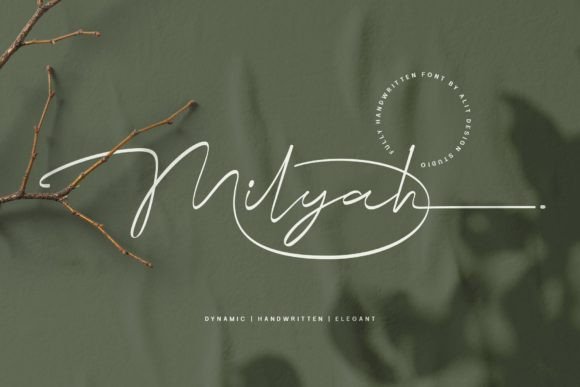
It started with a blank brand board — just me, a new client brief for a small-batch botanical skincare studio, and that familiar moment of scrolling through dozens of Script Handwritten fonts, searching for something that felt both timeless and unmistakably now. Then I opened Milyah. Instantly, it clicked: this wasn’t just another decorative script. Milyah is a stylish and elegant signature script font — one that carries the grace of traditional calligraphy but moves with quiet confidence in a modern context. No forced flourishes. No dated stiffness. Just clean, intentional flow.
Milyah for Skincare Branding and Botanical Packaging Design
I dropped Milyah into the logo draft first — not as a full wordmark, but as the studio’s name in a soft arch over a minimalist leaf icon. The contrast worked beautifully: the organic shape of the icon grounded the delicate energy of Milyah, while the font’s subtle stroke variation added warmth and human touch. For product labels, I used Milyah only on the hero line — “Lavender & Chamomile Serum” — paired with a light sans serif for ingredients and usage notes. That pairing created instant hierarchy: Milyah drew the eye, invited pause, and whispered care; the supporting type kept things legible and trustworthy.
On matte-finish sticker labels and kraft paper boxes, Milyah held up surprisingly well. Its generous x-height and open counters meant it stayed readable even at 14pt on a 2-inch label. And because Milyah is a stylish and elegant signature script font, it never looked “cute” or overly whimsical — a real win when balancing sophistication with approachability in natural skincare branding.
Milyah as a Display Font for Social Media Graphics and Print Collateral
In Instagram story templates, Milyah became my go-to for quote overlays and limited-edition launch banners. It’s a Script Handwritten font that feels personal without sacrificing polish — perfect for conveying authenticity in a crowded feed. I tested it against white, off-white, and deep sage backgrounds. On lighter tones, its fine hairlines sang; on darker ones, I bumped tracking slightly and used it at larger sizes — always keeping it as a display font, never body text. That’s key: Milyah shines brightest in short-form, high-impact moments.
For printed flyers and seasonal postcards, I leaned into its calligraphic soul — using alternate characters (like the swash ‘y’ and connected ‘th’ ligature) sparingly to add rhythm and intention. These weren’t gimmicks; they were thoughtful accents that made each piece feel hand-touched, not templated. As a font, Milyah doesn’t beg for attention — it earns it.
Milyah for Website Headers and Editorial Design in Creative Studios
The client’s site needed a homepage hero section that communicated calm, craft, and clarity. I set the headline — “Small-Batch. Thoughtfully Made.” — in Milyah, then paired it with a warm, neutral serif for subhead and body copy. That combination delivered exactly what the brief asked for: elegance without pretension, artistry without abstraction. Milyah functioned perfectly as a logo font and headline font, while the serif handled long-form readability with ease.
In editorial layouts — think ingredient spotlights or founder interviews in the studio’s digital zine — I reserved Milyah for pull quotes and section dividers. Its contemporary freshness kept the tone feeling current, while its classy calligraphic influences anchored the content in sincerity. This is where Milyah is a stylish and elegant signature script font truly proves its versatility: it adapts to voice, not the other way around.
Milyah Font Pairing Tips for Logo Design and Brand Systems
Pairing Milyah is intuitive but intentional. With serif fonts, choose something with gentle contrast and low stress — think a warm Garamond or a relaxed Playfair Display. With sans serifs, go for humanist styles: Lora for serif, Poppins or Manrope for sans. Avoid geometric or ultra-thin options — they clash with Milyah’s organic warmth. And skip other script fonts unless you’re deliberately layering textures (e.g., Milyah for the brand name, a bolder handwritten font for tagline). As a Script Handwritten font, Milyah stands strongest when given breathing room.
Milyah for Business Cards, Shop Signs, and Local Retail Identity
When designing the studio’s business card, I placed Milyah front and center — just the name, centered, in deep charcoal on uncoated cream stock. The texture of the paper softened its lines just enough, reinforcing tactility and care. For their small storefront sign, I scaled it up and tightened letter spacing slightly. Even at 36 inches wide, Milyah retained its character — no blurring, no awkward gaps. That’s a hallmark of a well-drawn font: it performs across scales and surfaces.
This is where Milyah is a stylish and elegant signature script font reveals its quiet power. It doesn’t shout. It invites. And in local retail spaces — where customers are choosing based on feeling as much as function — that invitation matters.
Testing Milyah Before Finalizing Your Brand Identity System
Before locking in Milyah across all assets, I ran three quick tests: First, I exported a PDF with mockups of packaging, web header, and social post — then viewed it on my phone, tablet, and desktop. Second, I printed a mini brand guide on actual label stock and held it under natural light. Third, I asked two non-designer friends (one in wellness, one in retail) to describe the vibe in one sentence. Their answers? “Trusted but tender,” “Handmade, not mass-produced,” and “I’d reach for that bottle first.” That’s how you know a Script Handwritten font like Milyah is working.
If you’re building a brand that values craftsmanship, calm, and quiet confidence — whether it’s a ceramic studio, a neighborhood café, or a slow-fashion label — Milyah isn’t just another font. It’s a tone-of-voice tool. A detail that signals intention. A Script Handwritten choice that helps your work land exactly where it should: memorable, meaningful, and unmistakably yours.